
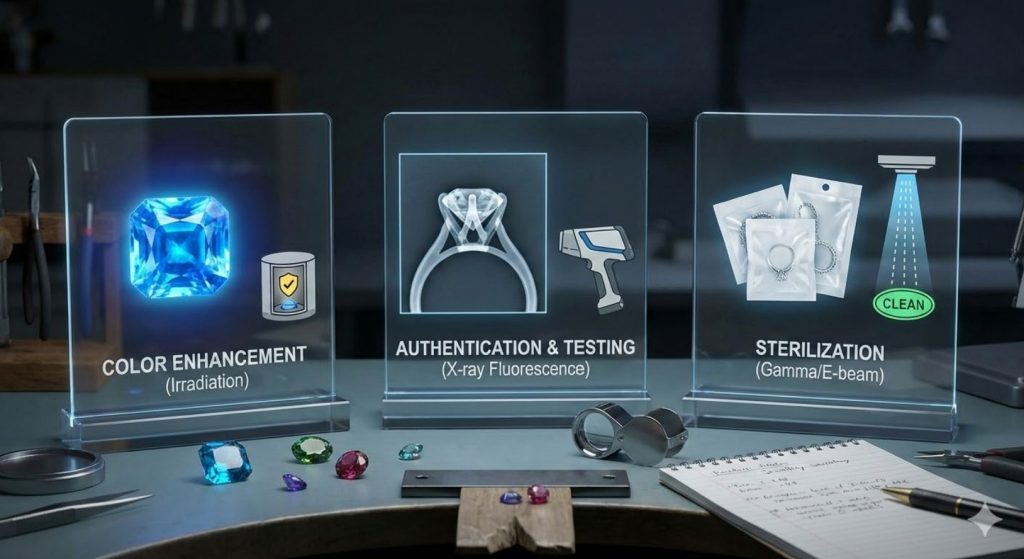
Jewellery is often associated with artistry, tradition, and emotion. Yet behind the sparkle of gold, diamonds, and gemstones lies a less visible influence of “science”. In India’s major jewellery hubs, radiation-based technologies are routinely used to verify purity, authenticate gemstones, and ensure quality, all while remaining invisible to the consumer.
From the diamond cutting floors of Surat to the gold markets of Thrissur, radiation technology supports accuracy, transparency, and trust all of this without altering the beauty of the final product.
Why Science Matters in Modern Jewellery
The jewellery industry operates on trust. A hallmark, a carat value, or a grading certificate represents assurance not just craftsmanship.
As production scales and supply chains become more complex, traditional methods alone are no longer sufficient. Modern jewellery hubs increasingly rely on non-destructive, radiation based technologies to meet expectations of accuracy, speed, and reliability.
Radiation-based analytical techniques meet these needs by allowing precious metals and gemstones to be examined internally without cutting, melting, or damaging them. International bodies recognise these techniques as established industrial applications when used under regulated conditions.
In India, regulatory frameworks from bodies such as the Bureau of Indian Standards (BIS) and the Atomic Energy Regulatory Board (AERB) ensure these technologies are used safely and responsibly.
Gold Purity Testing in Markets Like Thrissur
Thrissur, often called the Gold Capital of India, is home to thousands of jewellery manufacturers and retailers. One of the most widely adopted technologies in these markets is X-ray Fluorescence (XRF) testing.
How radiation is used
XRF instruments emit a low-energy X-ray beam onto the jewellery surface. The atoms in the metal respond by emitting characteristic signals unique to each element. By analysing these signals, the instrument determines:
• Gold purity (karat value)
• Alloy composition
• Presence of impurities
This method is officially recognised in India’s hallmarking ecosystem.
Regulatory backing
• The Bureau of Indian Standards (BIS) includes XRF as a non-destructive testing method for gold jewellery under its hallmarking framework.
• The Atomic Energy Regulatory Board (AERB) regulates the safe use of X-ray equipment in such industrial and commercial settings.
• The Department of Atomic Energy (DAE) lists jewellery and precious metal analysis among approved industrial applications of nuclear techniques.
These systems are shielded, low-dose, and operated by trained personnel. Consumers are not exposed to radiation, and jewellery does not become radioactive.
Diamonds and Radiation Technology in Surat
Surat processes the majority of the world’s rough diamonds by volume. At this scale, precision and consistency are essential — and radiation-based technologies play a critical role.
Diamond sorting and analysis
Advanced diamond processing relies on X-ray transmission (XRT), X-ray luminescence, and related imaging techniques to:
• Identify diamonds within rough material
• Analyse internal structure and inclusions
• Separate stones based on physical properties
Major industry players, including De Beers, have documented the use of X-ray–based systems for diamond sorting — technologies that are now widely adopted across cutting centres such as Surat.
Radiation-Treated Diamonds: Controlled and Regulated
Radiation is also used, under strictly controlled conditions, to modify the colour of certain diamonds.
Industry standards
• The Gemological Institute of America (GIA) documents radiation treatment as a recognised enhancement method.
• Such diamonds undergo mandatory decay periods and safety verification before entering the market.
• International guidelines require full disclosure of radiation treatment at the point of sale.
According to IAEA safety guidance and GIA research, radiation-treated diamonds are completely safe for wear once released for commercial use.
Quality Control Without Damage
Radiation-based inspection allows jewellers and manufacturers to:
• Detect internal flaws
• Verify material consistency
• Reduce rejection and rework
These techniques, similar to those used in aerospace and engineering inspection, are recognised by bodies such as the World Nuclear Association and Health Physics Society as standard non-destructive testing methods.
Safety as a Fundamental Principle
Radiation use in the jewellery industry is governed by the same principles applied across all regulated sectors:
• Minimal dose
• Shielded equipment
• Trained operators
• Continuous regulatory oversight
Organisations such as the ICRP and UNSCEAR emphasise that radiation exposure from industrial X-ray systems, when properly regulated, remains far below levels associated with health risk.
For consumers, wearing jewellery — whether tested or treated using radiation — poses no radiation exposure.
Conclusion
In India’s jewellery hubs, radiation technology works quietly behind the scenes. In Thrissur, it helps verify gold purity without damage. In Surat, it enables precision in diamond processing and authentication. Across the industry, it strengthens trust, transparency, and quality.
Radiation, when applied responsibly, is not a risk — it is a tool. One that allows craftsmanship and science to coexist, ensuring that beauty is matched by integrity.
References
1. International Atomic Energy Agency (IAEA) — Radiation Technologies in Industry and Trade
2. Bureau of Indian Standards (BISRadiation) — Hallmarking of Gold Jewellery and Artefacts
3. Atomic Energy Regulatory Board (AERB), India — Safety Guidelines for Industrial X-ray Equipment
4. Gemological Institute of America (GIA) — Diamond Treatments, Identification and Disclosure
5. De Beers Group — Diamond Sorting and X-ray Technology Publications