
Groundnut, also known as peanut, is a cornerstone of India’s agricultural economy. It supports farmer livelihoods, edible oil production, food processing, and regional trade networks. In Gujarat alone, groundnut cultivation and marketing form a critical link between farms and markets such as Bharuch, a well-known processing and wholesale hub.
Behind recent improvements in groundnut productivity lies an often-overlooked scientific tool: radiation technology. Applied carefully and responsibly, radiation has helped researchers develop groundnut varieties that are higher-yielding, more resilient, and better suited to India’s changing climate.
Why Improving Groundnut Matters
Groundnut cultivation faces persistent challenges:
• Yield losses due to drought and erratic rainfall
• Fungal diseases such as leaf spot
• Variability in seed quality and oil content
• Pressure to reduce chemical inputs
Conventional breeding methods remain essential, but they are time-intensive. Radiation-assisted plant breeding offers a complementary approach — accelerating natural variation while maintaining safety and genetic integrity.
Radiation Technology in Plant Breeding: A Simple Explanation
Radiation technology in agriculture is primarily used through mutation breeding.
In nature, mutations occur spontaneously over long periods. Mutation breeding uses controlled doses of ionising radiation, such as gamma rays, to slightly increase the rate of these natural changes. Scientists then identify and select plants showing beneficial traits.
Importantly:
• No foreign genes are added
• The process does not produce genetically modified organisms (GMOs)
• The radiation is applied only once, at the seed stage
This technique has been used worldwide for more than 70 years.
How Groundnut Seeds Are Improved Using Radiation
The process follows strict scientific and regulatory protocols:
1. Seed irradiation
Selected groundnut seeds are exposed to a carefully calibrated dose of gamma radiation at licensed facilities.
2. Field trials
Treated seeds are cultivated and monitored for growth, yield, disease resistance, and stress tolerance.
3. Selection and stabilisation
Promising plants are bred over several generations to ensure stable traits.
4. Release through official channels
Only thoroughly tested varieties are released to farmers.
At no stage does radiation remain in the plant or harvested groundnut.
BARC and Radiation-Developed Groundnut Varieties
India has played an active role in mutation breeding through institutions such as the Bhabha Atomic Research Centre (BARC), in collaboration with agricultural agencies.
One notable example is:
TG-73 (also registered as TAG-73 / GG-37)
• Developed at BARC using gamma-ray induced mutation breeding
• Derived from the parent variety TG-38
• Demonstrated:
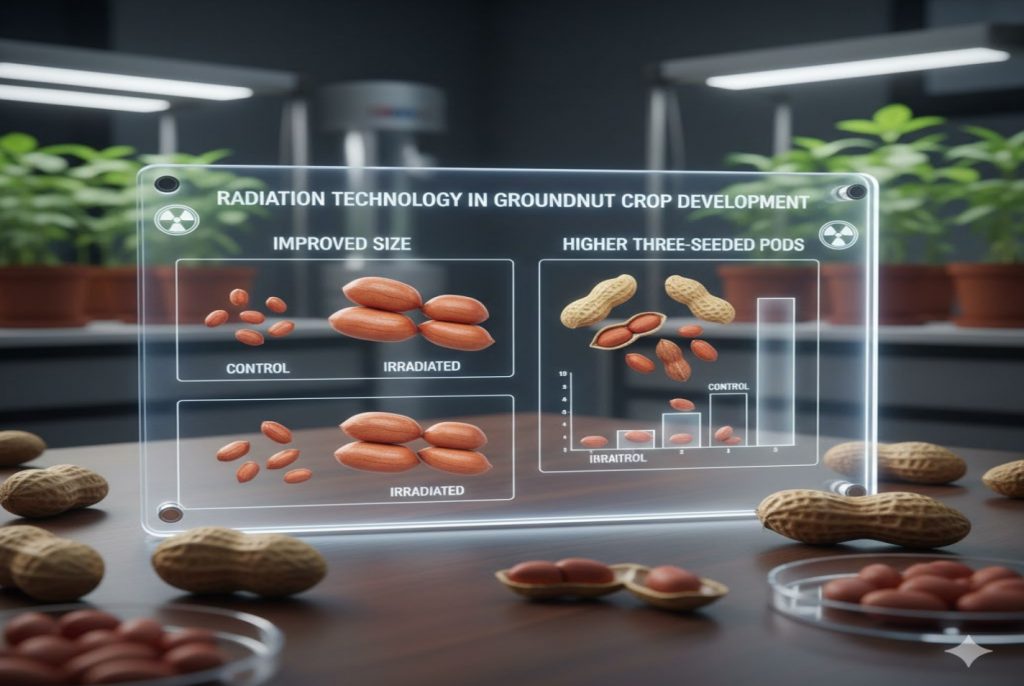
o Improved pod and kernel size
o Higher proportion of three-seeded pods
o Increased pod yield under summer cultivation
o Evaluated through multi-location trials in Gujarat and Maharashtra
This variety illustrates how radiation technology accelerates useful genetic variation while remaining within conventional breeding frameworks.
From Research to Market: The Role of Bharuch
While groundnut cultivation occurs across Gujarat, Bharuch district is recognised as a major processing and trading centre for groundnuts.
• Groundnuts from surrounding agricultural regions are brought to Bharuch for cleaning, grading, roasting, oil extraction, and wholesale distribution.
• The market supports food manufacturers, edible oil producers, and inter-state trade.
• Improvements in seed quality and yield directly strengthen this value chain, linking scientific innovation to economic impact.
Radiation-improved varieties contribute to consistent supply, better quality produce, and reduced losses — benefits that extend beyond the farm to markets like Bharuch.
Safety and Regulation
Radiation use in agriculture is governed by strict national and international safety standards:
• Licensed irradiation facilities
• Trained scientific personnel
• Regulatory oversight by Indian authorities
• Guidance from international bodies
According to the FAO, WHO, and IAEA, crops developed using mutation breeding are safe for cultivation
and consumption. The radiation does not make seeds, plants, or food radioactive.
Why This Technology Matters Today
In the context of climate stress and food security, radiation technology offers:
• Faster crop improvement
• Reduced dependence on chemical inputs
• Enhanced resilience for farmers
• Proven safety and global acceptance
For a crop as economically important as groundnut, these benefits translate into long-term agricultural sustainability.
Conclusion
Radiation technology in agriculture is not about altering nature, but about working with it more efficiently. Through mutation breeding, institutions like BARC have contributed to improved groundnut varieties that deliver higher yields, stronger resilience, and better quality.
From research fields to trading hubs such as Bharuch, radiation enabled innovation quietly supports farmers, markets, and consumers alike — demonstrating how nuclear science, when applied responsibly, strengthens food systems.
References
1. International Atomic Energy Agency (IAEA) — Mutation Breeding in Agriculture
2. Food and Agriculture Organization (FAO) — Plant Mutation Breeding and Crop Improvement
3. World Health Organization (WHO) — Safety of Foods Derived from Mutation Breeding
4. Bhabha Atomic Research Centre (BARC) — Trombay Groundnut (TG) Varieties and Mutation Breeding Research
5. Joint FAO/IAEA Programme — Nuclear Techniques for Food and Agriculture
6. Indian Council of Agricultural Research (ICAR) — Oilseed Crop Improvement Programmes